2.4 JUNCTION BREAKDOWN
when a sufficiently high field is applied to a p-n junction, the junction breaks down and conducts a very large current 11. Breakdown occurs only in the reverse-bias regime because high voltage can be applied resulting in high field. There are basically three breakdown mechanisms: (1) thermal instability, (2) tunneling, (3) avalanche multiplication . We consider the first two mechanisms briefly, and discuss avalanche multiplication in more detail.
2.4.1 Thermal Instability
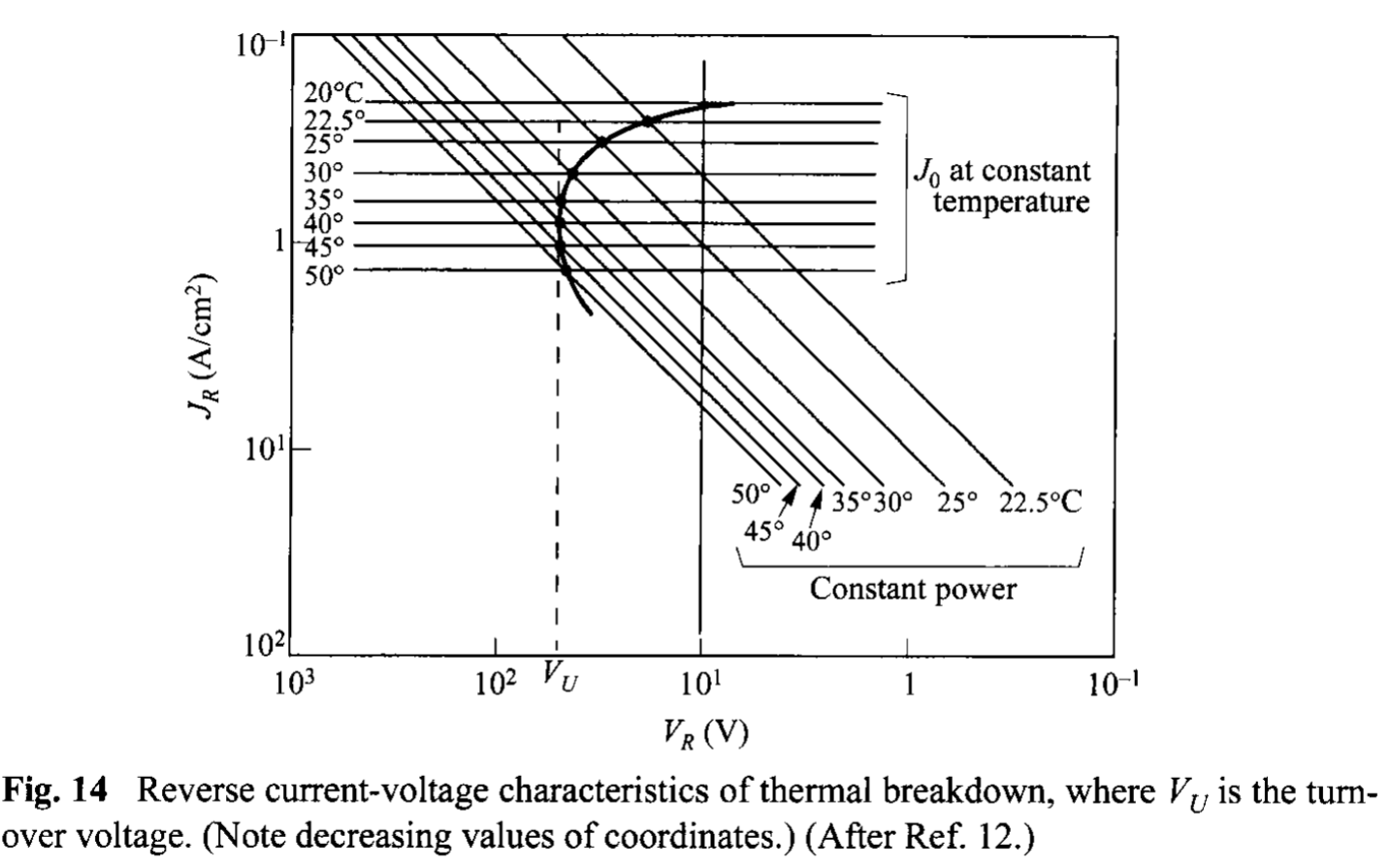
Breakdown due to thermal instability is responsible for the maximum dielectric strength in most insulators in most insulators at room temperature, and is also a major effect in semiconductors with relatively small bandgaps (e.g., Ge). Because of the heat dissipation caused by the reverse current at high reverse voltage, the junction temperature increases. This temperature increase, in turn, increases the reverse current in comparison with its value at lower voltages. This positive feedback is responsible for breakdown. The temperature effect on the reverse current-voltage characteristics is explained in Fig. 14. In this figure the reverse currents \(J_0\) are represented by a family of horizontal lines. Each line represents the current at a constant junction temperature, and the current varies as \(T^{3+\gamma / 2} \exp(- E_g / kT)\), as discussed previously. The heat dissipation hyperbolas which are proportional to the power, given by the \(I-V\) product, are shown as sloped straight lines in the log-log plot. These lines also have to satisfy the curves of constant junction temperature. So the reverse current-voltage characteristics are obtained by the intersection points of these two sets of curves. Because of the heat dissipation at high reverse voltage, the characteristics show a negative differential resistance. In this condition, the diode will be destroyed unless some special measure such as a large series-limiting resistor is used. This effect is called thermal instability or thermal runaway. The voltage \(V_U\) is called the turnover voltage. For p-n junctions with relatively large saturation currents (e.g. in Ge), the thermal instability is important at room temperature, but at very low temperatures it becomes less important compared with other mechanisms.
2.4.2 Tunneling
We next consider the tunneling effect (see Section 1.5.7) when the junction is under a large reverse bias. It is well known that carriers can tunnel through a potential barrier if this barrier is sufficiently thin, induced by a large field as shown in Fig. 15a. In this particular case, the barrier has a triangular shape with the maximum height given by the energy gap. The derivation of the tunneling current of a p-n junction (tunnel diode) is considered in details in Chapter 8, and the result is given here as: \[ J_t = \frac{\sqrt{2 m^* } q^3 \mathcal{E} V_R}{4 \pi^2 \hbar^2 \sqrt{E_g} }\exp \left( - \frac{4 \sqrt{2 m^* } E_g^{3/2} }{3 q \mathcal{E} \hbar} \right). \tag{92} \] Since the field is not constant, \(\mathcal{E}\) is some average field inside the junction.
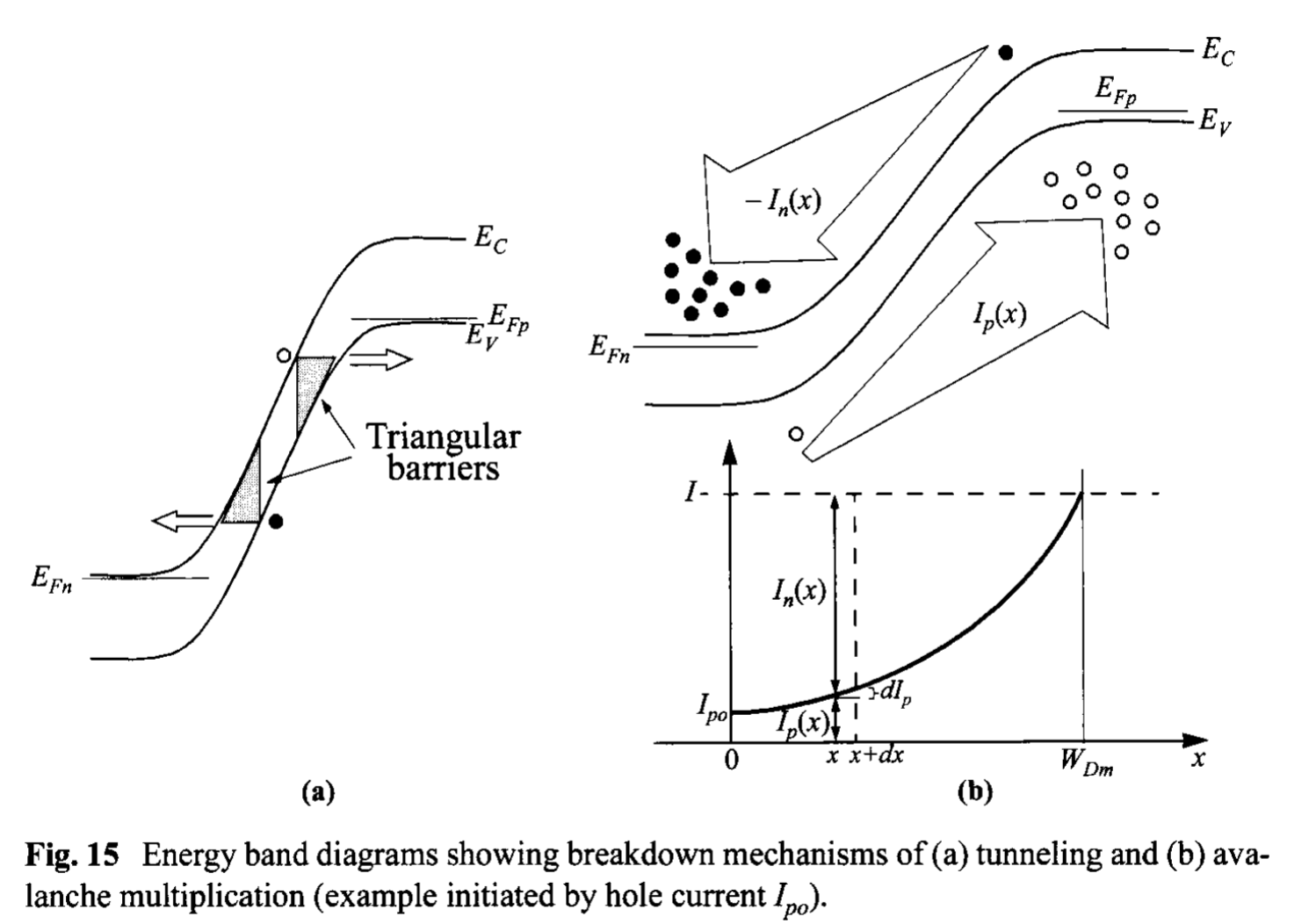
When the field approaches \(10^6\) V/cm in Si, significant current begins to flow by means of this band-to-band tunneling process. To obtain such a high field, the junction must have relatively high impurity concentrations on both the p- and *n-*side. The mechanism of breakdown for p-n junctions with breakdown voltages less than about \(4 E_g/q\) is due to the tunneling effect. For junction with breakdown voltages in excess of \(6 E_g/q\) , the mechanism is caused by avalanche multiplication. At voltages between \(4\) and \(6 E_g/q\), the breakdown is due to a mixture of both avalanche and tunneling. Since the energy bandgaps \(E_g\) in Si and GaAs decrease with increasing temperature (refer to Chapter 1), the breakdown voltage in these semiconductors due to the tunneling effect has a negative temperature coefficient; that is, the breakdown current \(J_t\) can be reached at smaller reverse voltages (or fields) at higher temperatures (Eq. 92). This temperature effect is generally used to distinguish the tunneling mechanism from the avalanche mechanism, which has a positive temperature coefficient; that is, the breakdown voltage increases with increasing temperature.